Hello 2022! I maybe slightly suspicious of the new year after what has happened the last two years, but I hope that everyone thoroughly enjoyed their New Years celebrations! I was out of town with family, where there was a nice romantic rain backdropping beautiful ironwork, and arrived back home just in time for half a foot of snow. 80 degrees to 20 degrees, or 26.6667 C to -6.66667 C. At this point, I am not sure whether I should break out the swimsuit or the snowshoes.

But, thank you all for understanding be pushing back the episode release to this morning. It was pretty nice to curl up with a Hot Coco, blanket, and the kitten and write the episode. So while I am curling up with a heated blanket and finding a parka, please enjoy the first episode of the Second Season and enjoy 2022.

Transcript:
Sound: Coffee pouring into the Glass.
It’s time for Architecture, Coffee, & Ink.
30 second Intro song
Hello, this is Hollywood C. and you’re listening to Architecture, Coffee, & Ink. A podcast dedicated to introducing concepts, detailing out designs, and tackling the architecture you might not realize the meaning behind. I’m your hostess and I am here today to start introducing you to the designs that make you wonder why.
tag line: So I ask you to brew your coffee, grab your sketch book and pen, and let’s begin.
Happy New Year everyone! Welcome to 2022! Whether you partied it up in NYC or had a nice relaxing holiday away from work, I hope everyone managed to enjoy it. It’s always wonderful to spend time away with friends and family, but the real world is fast approaching for many of us. I have begun reaching out to do more interviews again, and thinking about the fast approaching Spring Semester-updating my portfolio website and portfolio, and starting to write down all my previous promised of episodes, BONUS shows, and plans for the future. I am a pretty big into delivering promises and working around a schedule, so I should have all of that nailed down in the next week and color coded for when each episode and subject should be aired. I have also started reading a few more books in earnest, and looking into the topic of social architecture-if you have a recommendation or a suggestion for a book or paper, let me know!
So, this week, I am going to be talking about Angkor & Angkor Wat in Cambodia. So, this location is actually 100% on my bucket list of locations I would love to study in person. Whatever unfortunate soul I manage to drag with me, is probably going to have to use a crowbar to pry me off the grounds and get back to the airport on time, but, that is neither here nor there. Now before we dive into the site itself, we need to take a second and talk about the history and the people, as many of you have guessed that is one of my favorite parts of understanding architecture and sites. To me, the idea of breaking down what led to the construction of the place and the people is equally as important to understanding how and where the walls are positioned and the way that the joints come together.

So this site was actually underneath the Khmer Empire, in what is currently Cambodia. And if you use Instagram, or any social media feed, you have probably seen a picture of it-which we will get to a little bit later in the episode. So, because we have some younger listeners now who may not be as familiar with World Geography, I am referring to the area of Asia that is underneath China and East of India-by Thailand and Vietnam. While the Khmer empire stretched out beyond the borders of modern Cambodia, Angkor, the capital was located just to the north of the Great Lake. The empire had borders that stretched from the Gulf of Thailand and the South China Sea. I have actually included some music I found on FreeSound that is considered to be from the Khmer, in the background of the episode at times. As always, my links will be on the blog page, so if you want to hear more please check it out.
Overall, the Khmer Empire lasted from 802 CE to 1431 CE, and many of the themes we discussed in the Maya And Meroe episode are going to be repeated here as well. War and trade were a huge driving factor between the development of the culture-the constant influx of people and ideas being brandied about resulted in strong influences. In particular, if you look at the images on the blog of the buildings and temples, you can really pick out where traces of the surrounding kingdoms may have played a huge role. However, the ruler Jayavarman II was the man who really kicked off the empire in 802 CE. He started at his home city, believed to be Java and marched through the area until he landed on Angkor, taking the title of chakravartin-and established himself as a God-King. Now, the idea that the kings are either a representation of the gods, or ruling by divine right is not something particularly new in the world as a whole. Or even the idea that the king is a God. Prior to the formation of the God-kings rule, all of the people would have been in much smaller grouping, whether as after his campaign it is an Empire. Underneath their God-Kings, they began building Angkor Wat in 1122, until it was looted in 1177 by the Chams. Though it was later restored by King Jayavarman VII. If you never hear another name associated with the site, remember the II and the VII. The VII was the most aggressive builder, I watched three different documentaries-and the VII was the only name mentioned in all three, and the only name I knew before even conducting research on the episode. There was actually somewhere around 38 kings, over the course of the whole run-which is the roughly 9th-15th centuries. So while there was a lot of history, and a lot that is removed and condensed into documentaries, the II and the VII are attributed with both the beginning and the end of the Empire. Even though the VII was attributed with the massive construction and the start of the height of the city, he is considered by some of my sources as a beginning to the end. It reminds me a lot of the story of Icarus, the boy who flew too close to the sun. Anyway, as I mentioned before, the history of the empire was littered with conflict and war. As it happened, attempts at invasions occurred, including the successful one by the Chams from Vietnam, as well as the Siam from Thailand.
Among the buildings, which numbered in the 1000s, among which was Angkor Wat, they developed a series of channels and irrigation systems. As many locations in the world, the success of the city and the people was dependent on water. And the movement of water around the region. It limited just how far people could move away, and where they could grow their crops-the most important or rather, the staple of the diet would have been rice. Luckily, the empire was exceedingly brilliant at engineering and were able to create and move so much water, that the population and size of Angkor swelled into an official metropolis. Unfortunately, that and the changing in religions may have led to the eventual downfall of the Empire. In the Empire, they would have primary been practicing Hinduism, but eventually there was Buddhism as well. Hinduism is what most strongly influences our site, as the Angkor Wat-the most famous of temple of the city of Angkor, is an example of the Hindu Universe. Now, when I say that a switch to Buddhism was the downfall, I am not hating on the religion, what I mean is that when the people switched religions, they would have no longer thought of the King as a God, meaning that following his rules was no longer a religious or moral obligation, but a civic duty. The ties to the king would have weaken, as it did for several other cultures around the world. It’s one thing to think that you can’t rebel again your king without directly offending your Gods and condemning yourself, and another to vote a human out of power.
Another issue leading to the downfall, could have been the technology. Some of the research I was looking into mentioned how they were studying the rings of trees, to determine water levels, droughts, and floods. The engineering of the city was impressive and beyond anything that existed at the time, I mean, it allowed for the creation of the largest temple in the world, come on. But, it was delicate. Meaning if too much water or not enough was around, the channels and sprawl of the people would have backfired on the Empire-no regular maintenance because you maxed out your resources, or built too much to maintain and suddenly you would have Rice farmers and entire communities dependent on fishing as a primary food source, without. These or even diseases, the Thais coming in and sacking the regions and carrying off the harems and wives, all could have attributed to the eventual collapse of the empire. Now, here is the part of the story, or all stories of archaeological sites, that I struggle with. So in 1431 CE, we know that the Thai invaded and the Empire was officially labeled as done-HOWEVER, locals and some people would have moved away closer to the water, or lived locally. Much like we discussed in previous episodes. Cambodia has a Monsoon season and a dry season. For 8 months roughly, it is going to be completely dry-hence why the channels were needed, and the rest of the time you will get monsoons and storms. This combination of flooding and dry wreaked havoc on the ruins, and allowed the whole of the complex to get swallowed up by the jungle.

But in 1860, M. Henri Mouhot would re-discover the city and more importantly, Angkor Wat. He was start the series of studies and reconstruction efforts that would continue into today. Now, unfortunately, he had his problems, he was apparently looking for bugs when he was found the city, so like, clearly no one is perfect. But he also was rumored to not be a fan of colonialism and was willing to at least consider how being “blind instruments of boundless ambition…” was a bad thing. That passage was taken from his books and included on his wiki page, but with the books, I haven’t read them, so I genuinely cannot speak to how much it makes sense within the larger context of the travel journals. I have only read a few excerpts and translations of chapters, not the whole of the 3-4 volumes I know were published. I also tend not to trust translations until I can see copies of the original texts. I had a language teacher teach us the value in that and let’s just say it’s a hard learned lesson I won’t soon forget.
But, this brief history leads us into our site today. So you will see it online as both a Buddhist temple and a Hindu Temple. And the answer to which one it is, is Yes. It was built Hindu and was converted into Buddhist. So, depending on the source, and where they are getting there information, kind of leads you to which way they view it. To me, it is both, as you can’t really exclude one part of the history, and even now, you are not supposed to show knees and shoulders when visiting the site. So, it was originally built around the 113 BC, and is believed to have taken roughly 30 years. It was originally dedicated to Vishnu and was started by King Suryavarman II. The city of Angkor, because remember, we are talking about two things: the city and the individual temple-but the city is roughly 400 km^2, and is part of the UNESCO protected sites, underneath the Angkor Archaeological Park. The part that gets me, is that this region covers temples, channels, and is so large, that in 1994, they had to ask NASA to get lidar from space to see all of it. Like, the scope and size of something that is not talked about as often as other empire in school, is insane.

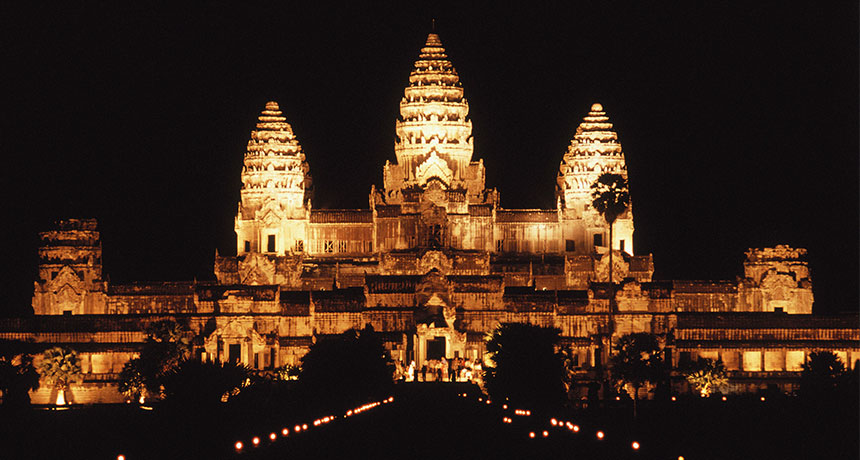
So, onto the architecture. As I mentioned before, Angkor Wat, is the largest of the temples. It still has an incredibly square moat, and square building. That was built structurally with laterite, and then covered in sandstone so incredibly perfectly carved that one of the sources said that you wouldn’t have been able to get a piece of paper through it. Now, when it was rediscovered in 1860, it was crumbling, and would had trees growing in it-like one of the most famous and frequently re-blogged/re-photographed moments. I would be incredibly surprised if you hadn’t seen a picture of the temple in the middle of the jungle with the tree growing into-Davy Jones Style. The infamous towers resemble lotus buds and the entirety of the temple is carved in breathtaking reliefs-so breathtaking that having tourist keep their hands to themselves remains a huge problem. Which is especially horrible, when you realize that the restoration started way back in 1860, and this temple was somewhere around 900+ years old.
The temple itself is a representation of Mount Meru, the home of the gods and is oriented to the west. The Bas-reliefs cover all of the site, which is a mixture of 3 galleries, four towers, central spire, moat and outer wall. Now, in popular culture, it remains a pilgrimage site, and is on the Cambodian flag. Additionally, it is covered in Sanskrit, which has been translated and is being studied to help understand the people and the history of the location. An additional source for information has come from Zhou Daguan, who visited for a long time, and recorded his observations in a journal-or travelogues-this was during the 13th century. However, if you read any of his writing, please use your critical thinking skills. According to one of my sources, he was “prone to flights of fancy” I think is how they wrote it. Apparently, he believed that a Chinese architect built it in a day, and was prone to exaggerate. He also apparently called his hosts mean names, and thought they were doing life wrong. He was basically picking and choosing what he agreed with and what he didn’t and was justifying it based on his own experiences and beliefs. But to be fair, he did include information about the punishment systems and discipline used. I really doubt he was planning on some chick in 2022 throwing shade his way. I saw on another source, that he supposedly thought it was a God, but I am quoting Nat Geographic, because, they also included other sources and quotes from him-so I trust it as a better source then the second.
Within the architecture itself, the combination of the building and the moats, would represent water and mountains. And each tower would have been an ogival. Be careful looking at plans online. The structures are actually several levels, at times they are 3 or more, with the tallest tower reaching 213m or 699 ft. When I was looking for plans I noticed several that were fan made, not architects or archaeologist, and the denotations are not always consistent. So some you could tell were confused about which level was above the other, and marked them really randomly. Not all of them, but remember, check your sources, check your facts, and check me. Make sure you use more than one source, and compare all the information available.

This site is currently included on the wonders of the world by UNESCO, and was in-scripted in 1992, and since then, tourism has dramatically increased. It may still be a site of worship, but the feats of engineering, architecture and design, showcase a civilization that was quite frankly, years ahead of its time. Soaring within just the city to a size of London or Los Angeles. Encompassed with a series of gateways and causeways quadrating off spaces, this is a marvel to behold. The reliefs encompassing the structure include battles, scenes of judgment, and gods and demons fighting. Some of them are particular to the king who started the temple, and others are particular to religion with cardinal directions operating as major points, and bas-reliefs working, and the corbel domes of the Angkor Thom, and the Bayon built by our favorite guy, VII. To finish out, I will mentioned that there are several virtual classrooms, and teaching modules available online. So if you are interested in learning more than what I can fit into a small episode, I would definitely give that a try.
Thank you everyone for being so understanding of me traveling this past weekend. It’s my last trip for a few days, so I will be able to recuperate from the long drive and get my head back into architecture. But once again a big thank you to all my listeners! I am now on iHeartRadio, so for those would were asking, it is officially a thing. I know I say this every week, but please: Please rate and review.
If you want more episodes, or longer ones, or shorter, let me know! We again have a Facebook page and private group, both of which are under the same name: Architecture, Coffee, & Ink. https://architectureink.design.blog/, is the website, Everything will be linked in the show notes. Have a wonderful new year and as always,
May your coffee mugs be full, and your ink wells never run dry.
60 secs end song re-looped.
Sources:
“Angkor Archaeological Park.” Wikitravel. Accessed January 6, 2022. https://wikitravel.org/en/Angkor_Archaeological_Park.
“Angkor Wat.” Encyclopædia Britannica. Encyclopædia Britannica, inc. Accessed January 6, 2022. https://www.britannica.com/topic/Angkor-Wat.
“Angkor Wat.” Wikipedia. Wikimedia Foundation, January 6, 2022. https://en.wikipedia.org/wiki/Angkor_Wat.
“Angkor: Asia’s Ancient ‘Hydraulic City’.” BBC Travel. BBC. Accessed January 6, 2022. https://www.bbc.com/travel/article/20211201-angkor-asias-ancient-hydraulic-city.
“Bayon: Cambodia Attractions.” Lonely Planet, July 8, 2021. https://www.lonelyplanet.com/cambodia/angkor-thom/attractions/bayon/a/poi-sig/500534/1318768.
“The Buried Mysteries of Angkor Wat | The City of God Kings | Timeline.” YouTube. YouTube, July 15, 2017. https://www.youtube.com/watch?v=KsDGDzwuQ-I.
“Cambodia Weather.” Climate and Seasons in Cambodia – Go Guides. Accessed January 6, 2022. https://www.hotels.com/go/cambodia/cambodia-weather.
Carter, Alison K., Miriam T. Stark, Seth Quintus, Yijie Zhuang, Hong Wang, Piphal Heng, and Rachna Chhay. “Temple Occupation and the Tempo of Collapse at Angkor Wat, Cambodia.” PNAS. National Academy of Sciences, June 18, 2019. https://www.pnas.org/content/116/25/12226.
Centre, UNESCO World Heritage. “Angkor.” UNESCO World Heritage Centre. Accessed January 6, 2022. https://whc.unesco.org/en/list/668/.
Google image result for https://i2.wp.com/asianreviewofbooks.com/content/wp-content/uploads/2020/05/angkor-wat.jpg?fit=1200%2c890&ssl=1. Google. Accessed January 6, 2022. https://www.google.com/imgres?imgurl=https%3A%2F%2Fi2.wp.com%2Fasianreviewofbooks.com%2Fcontent%2Fwp-content%2Fuploads%2F2020%2F05%2Fangkor-wat.jpg%3Ffit%3D1200%252C890%26ssl%3D1&imgrefurl=https%3A%2F%2Fasianreviewofbooks.com%2Fcontent%2Fangkor-wat-a-transcultural-history-of-heritage-by-michael-falser%2F&tbnid=pGqdFu6pfh6oyM&vet=12ahUKEwjyyaHG85v1AhUEUFMKHfkvB7wQMyhIegQIARBh..i&docid=PFFrNB2mFQ5ezM&w=1200&h=890&q=angkor+wat&ved=2ahUKEwjyyaHG85v1AhUEUFMKHfkvB7wQMyhIegQIARBh.
Google image result for https://images.adsttc.com/media/images/562d/9db8/e58e/ce22/ae00/023d/large_jpg/5148522141_61fc7803d4_o.jpg?1445830066. Google. Accessed January 6, 2022. https://www.google.com/imgres?imgurl=https%3A%2F%2Fimages.adsttc.com%2Fmedia%2Fimages%2F562d%2F9db8%2Fe58e%2Fce22%2Fae00%2F023d%2Flarge_jpg%2F5148522141_61fc7803d4_o.jpg%3F1445830066&imgrefurl=https%3A%2F%2Fwww.archdaily.com%2F101004%2Fad-classics-angkor-wat&tbnid=nGKHXEGY_mulzM&vet=12ahUKEwjyyaHG85v1AhUEUFMKHfkvB7wQMyhCegQIARBV..i&docid=kmrKNCTmrGbR3M&w=1024&h=665&q=angkor+wat&ved=2ahUKEwjyyaHG85v1AhUEUFMKHfkvB7wQMyhCegQIARBV.
Google image result for https://lp-cms-production.imgix.net/2021-11/gettyimages-1304987250.jpg?auto=format&fit=crop&sharp=10&vib=20&ixlib=react-8.6.4&w=850. Google. Accessed January 6, 2022. https://www.google.com/imgres?imgurl=https%3A%2F%2Flp-cms-production.imgix.net%2F2021-11%2FGettyImages-1304987250.jpg%3Fauto%3Dformat%26fit%3Dcrop%26sharp%3D10%26vib%3D20%26ixlib%3Dreact-8.6.4%26w%3D850&imgrefurl=https%3A%2F%2Fwww.lonelyplanet.com%2Farticles%2Fcambodia-siem-reap-beyond-the-temples&tbnid=jz35RnQ068ToiM&vet=12ahUKEwjyyaHG85v1AhUEUFMKHfkvB7wQMygdegUIARDuAQ..i&docid=estXLvzszYEdiM&w=850&h=566&q=angkor+wat&ved=2ahUKEwjyyaHG85v1AhUEUFMKHfkvB7wQMygdegUIARDuAQ.
Google image result for https://www.sciencenews.org/wp-content/uploads/2016/04/051416_angkor-wat-main_free.jpg. Google. Accessed January 6, 2022. https://www.google.com/imgres?imgurl=https%3A%2F%2Fwww.sciencenews.org%2Fwp-content%2Fuploads%2F2016%2F04%2F051416_angkor-wat-main_free.jpg&imgrefurl=https%3A%2F%2Fwww.sciencenews.org%2Farticle%2Flasers-unveil-secrets-and-mysteries-angkor-wat&tbnid=ZdZUilOxF8Z0KM&vet=12ahUKEwjyyaHG85v1AhUEUFMKHfkvB7wQMyguegUIARCSAg..i&docid=4INozItoRKtGjM&w=860&h=460&q=angkor+wat&ved=2ahUKEwjyyaHG85v1AhUEUFMKHfkvB7wQMyguegUIARCSAg.
Google search. Google. Accessed January 6, 2022. https://www.google.com/search?q=angkor%2Bthom&rlz=1C1CHBF_enUS910US910&tbm=isch&source=iu&ictx=1&fir=hjdUXfAGVQB2bM%252CJosQR5sNO2uXqM%252C%252Fm%252F025x6k%253ByBAuL2XnTM7OFM%252CYGFOmEMgNVVZjM%252C_%253Bn3GI9sNkSyaexM%252CO0ep_UxGNlnppM%252C_%253B2OTsTOQVWMGJfM%252CxVpaOgWUaqfxUM%252C_&vet=1&usg=AI4_-kSErS8abCMvVfEwq7JwA9eMKcLwDw&sa=X&sqi=2&ved=2ahUKEwjB25zGrpz1AhVOyhoKHZQ5CuUQ_B16BAgwEAE#imgrc=9f3-lO7hp-FDaM.
Google search. Google. Accessed January 6, 2022. https://www.google.com/search?q=angkor%2Bwat&rlz=1C1CHBF_enUS910US910&source=lnms&tbm=isch&sa=X&ved=2ahUKEwiuyLij3Zv1AhU5RzABHbZWAxQ4ChD8BSgBegQIARAD&biw=1536&bih=722&dpr=1.25.
Google search. Google. Accessed January 6, 2022. https://www.google.com/search?q=corbel%2Bangkor%2B&tbm=isch&ved=2ahUKEwiL-7Sjrpz1AhUXQkIHHTExBf4Q2-cCegQIABAA&oq=corbel%2Bangkor%2B&gs_lcp=CgNpbWcQAzoECAAQQzoFCAAQgAQ6BggAEAgQHjoECAAQGFAAWPIdYNQgaABwAHgAgAFWiAHhBJIBATiYAQCgAQGqAQtnd3Mtd2l6LWltZ8ABAQ&sclient=img&ei=03nWYcvFJZeEieoPseKU8A8&rlz=1C1CHBF_enUS910US910#imgrc=2AdyoBocF_amTM.
Google. Google. Accessed January 6, 2022. https://www.google.com/maps/about/behind-the-scenes/streetview/treks/angkor/.
“Henri Mouhot.” Wikipedia. Wikimedia Foundation, October 14, 2020. https://en.wikipedia.org/wiki/Henri_Mouhot.
“Henri Mouhot.” Wikipedia. Wikimedia Foundation, October 14, 2020. https://en.wikipedia.org/wiki/Henri_Mouhot.
History.com Editors. “Angkor Wat.” History.com. A&E Television Networks, February 28, 2018. https://www.history.com/topics/landmarks/angkor-wat.
NationalGeographic. “Angkor Wat (Full Episode) | Access 360 World Heritage.” YouTube. YouTube, June 19, 2021. https://www.youtube.com/watch?v=C5jpbwizxBs.
NationalGeographic. “Before You Visit Angkor Wat, Here’s What You Need to Know | National Geographic.” YouTube. YouTube, September 30, 2017. https://www.youtube.com/watch?v=NJyCKj8pCiY.
Plubins, Rodrigo Quijada. “Khmer Empire.” World History Encyclopedia. World History Encyclopedia, January 4, 2022. https://www.worldhistory.org/Khmer_Empire/.
Ray, Nick. “Angkor Wat: Get to Know Cambodia’s Most Iconic Temple.” Lonely Planet. Lonely Planet, September 9, 2021. https://www.lonelyplanet.com/articles/cambodia-famous-temple-angkor-wat-info.
Rod-ari, Dr. Melody, and Dr. Melody Rod-ari. “Angkor Wat.” Smarthistory. Accessed January 6, 2022. https://smarthistory.org/angkor-wat/.
TourismCambodia.com. “Angkor Wat – 7th Wonder of the World – Angkor Archeological Park – Angkor Wat Guide – What to See in Cambodia – Cambodia Major Attractions: Tourism Cambodia.” Angkor Archeological Park – Angkor Wat Guide – What to See in Cambodia – Cambodia Major Attractions | Tourism Cambodia. Accessed January 6, 2022. https://www.tourismcambodia.com/attractions/angkor/angkor-wat.htm.
“Virtual Angkor.” Virtual Angkor. Accessed January 6, 2022. https://www.virtualangkor.com/.